All Life Is a Pool: Louise Tucker and Her Passion for Battle Ground
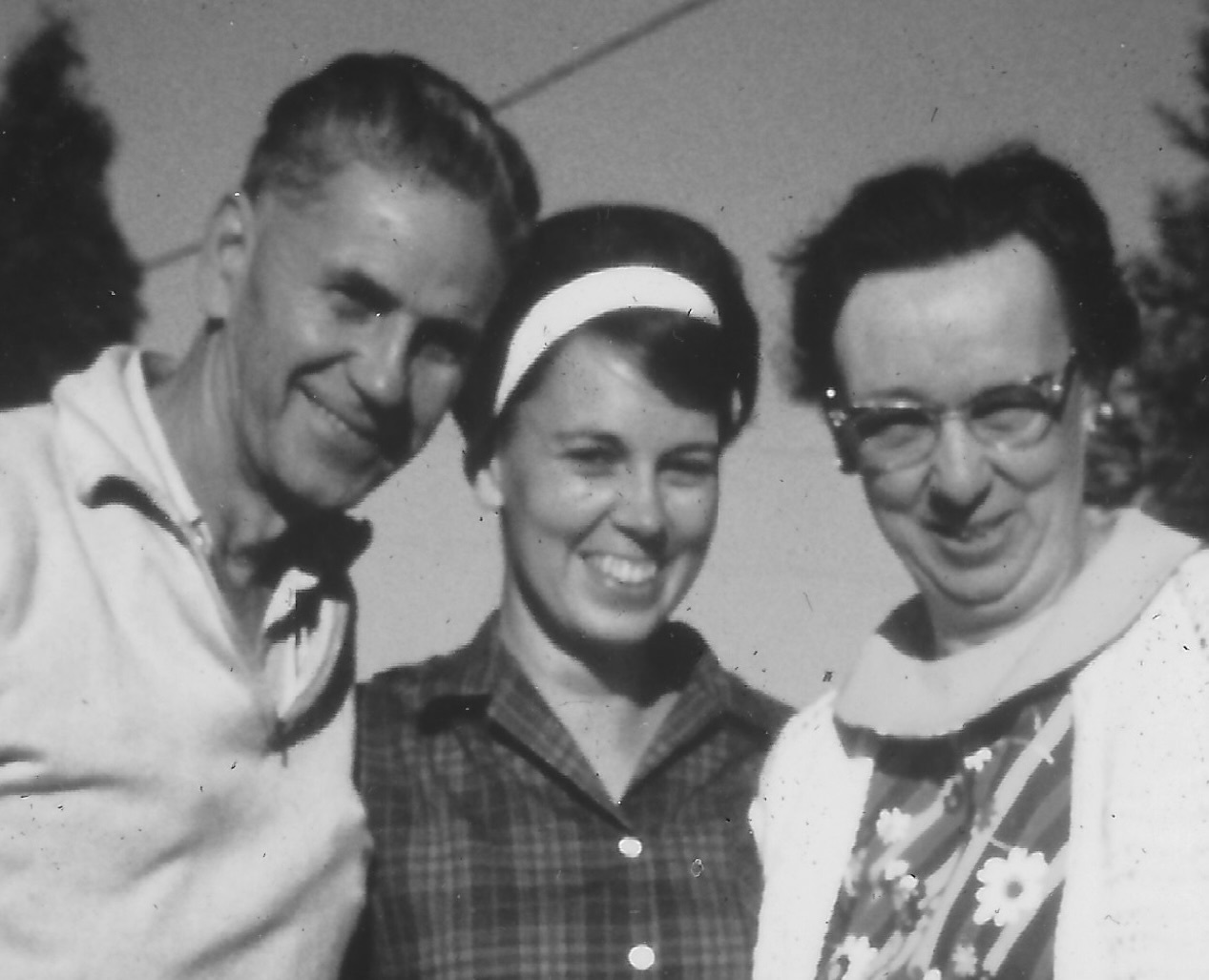
Louise in the late 1950s, flanked by her father and mother, Fred and Betty McKay.
Life in a small town is not small. Getting up in the morning, going to work, kissing the cheeks of friends, having coffee in the evening, praying quietly and earnestly. These things, and more, are not going to make it into most history books. But they are the fabric of our actual lives. And the rest of the details—how we built our houses, what we did at work, the specific way we planed the wood, or lit the fire, or milled the paper, those things are especially vulnerable to time. They don't compare to an Archduke in Sarajevo, or a volcanic eruption that blankets hundreds of miles of city and country in toxic ash.
Except that Louise Tucker believes they do. In 1976, during the nation's bicentennial, the first printing of Battle Ground In and Around alit from the printer's press and into readers' hands. A large, heavy tome of 400 pages, bound in red leatherette, was written and compiled by Louise while working as The Reflector's advertising manager. Battle Ground In and Around serves as a chronicle of life in and around a small town, beginning at the establishment of Clark County in Washington Territory, up to the lean years of the Great Depression, and then "dwindling into the present" after the Depression. "Lots of history doesn't actually tell how people lived. It centers on officials—mostly men. I wanted people to be able to read about how people did their jobs, like logging…or just feeding chickens in the yard. I wanted people to feel like they were living right along with the early settlers."
The families of these early settlers, who believed in and supported the project, provided over a thousand action photos. The result is a serious pictorial history, rather than a compendium of "good family stories," only designed to be sold back to the same people who had provided material. The Reflector supported Louise's project, printing a call for local stories that might be relevant to the book. Battle Ground's General Confederation of Women's Clubs (the GFWC, who affectionately refer to themselves as the 'Girlfriends Who Care') also provided hands and hearts to the cause.
Since then, GFWC has worked with Louise to produce the local history booklet, Battle Ground Lake Before It Became a State Park (2023), which features photos and historical notes from the park's former life. It is available only from Literary Leftovers, which Louise describes as "Battle Ground’s classy used bookstore." Profits from the booklet are poured back into community service projects.
Louise worked for more than three years on Battle Ground In and Around before it was ready for its first printing by a shop called Taylor Publishing, who had printed Louise's high school yearbooks. The job was good, but when Louise contacted them to print a second, she discovered they had lost the plates. To reproduce the book, Louise deconstructed an existing copy of the first print and sent it to the publishers of the local newspaper, The Camas Post. Another snag. When the pages arrived at the bindery, an incredible amount were smudged, blurred, and out of order. "I called The Post and just let them know that, well, I was not happy," Louise said. So The Post assembled a team of local housewives and other volunteers to sort through the pages manually, remove the unusables, and put the rest in order. After all of that, Louise wasn't keen on a third printing, but enthusiasm from the local community convinced her to engage Marvin Case, publisher of The Reflector, to “job-out” the printing and binding of a third printing. That was the final printing of this iconic volume. As of 2023, the book is out of print, and resells online for between $70 and $140.
The truth is that anyone in Battle Ground ought to know the name Louise Tucker. Her notoriety is due to her deep involvement with the community. She began an early GFWC chapter in Battle Ground, worked for The Reflector, and volunteered with the Friends of the Battle Ground Community Library. She led her church's women's group and served as congregational secretary. She is an active member of the Daughters of the Pioneers of Washington and with her husband, Bill Tucker, coordinated the team of volunteers who produced a prize-winning Battle Ground float in the Portland Rose Festival Parade for many years. In conversation, this volunteer work is what she most emphasizes. "I think people grow if they get involved in volunteering in the community. It's the best way to improve a community." She says nowadays, "A lot of people will do something if you ask them to, but they want to know exactly what you want them to do and how long it will take. They don't, I think they don't want to be too responsible for anything."
Louise has, it seems, always been ready to take on whatever was asked of her, and to commit to it fully. If someone in the community expressed interest in something, Louise would make it happen, even if she had to teach herself how to do it. An autodidact, she has taught herself advertising, writing, and history, usually while on the job. "When you don't know how to do something, you learn," she said, matter-of-fact. In this way, Battle Ground In and Around as well as Battle Ground Lake Before It Became a State Park and other projects came to be.
Louise insists that she has done most of her writing for other people, but in her private life, she also writes poetry, and very humorous short stories. One story, which won the GFWC's short story award, tells the true story of a Battle Ground man who convinces his wife she is shrinking, by raising their dining room table just a bit each day. Her poetry is contemplative, devotional, and often about nature.
All life is a pool
With amazing depths, secrets, distortions,
Ever changing reflections.
Friends breaking through the surface create circles
That meet the circles of other friends.
Aloneness.
The mirror seems impervious once again.
The mystery is regained; the hiding place restored.
But friends will break through again.
(Excerpted from 'The Pool'.)
Now, after 37 years, Louise and her husband, Bill Tucker, are selling their Battle Ground home and moving into an adult living facility. When I come to see her, the trees around the house are very green. A rowan near the front door is flush with clusters of little orange berries. The house is packed up. The art, much of it made by Louise's hand, has been removed from the walls. The woodburning stove in the front room is still stocked with handcut firewood and kindling, though it's mid-August. Louise has just turned 90. She's as interesting as ever to talk to, moving effortlessly from the recent library levy, to the vanity of women, to the booklet of family history she's putting together. Just for private enjoyment, she says, not for the public this time.
The service Louise has done for Battle Ground over the decades can't be quantified. Every town should be so lucky, to have someone who takes a real interest in its happenings and history, who not only wants to see it better itself, but is willing to do the work. And is she sad to leave Battle Ground, after all this time? With no hesitation, Louise replies, "Oh, I'm coming back. Our friends are here. My life is still here."