World War II and Korean War Veteran
Bernie Ruchin
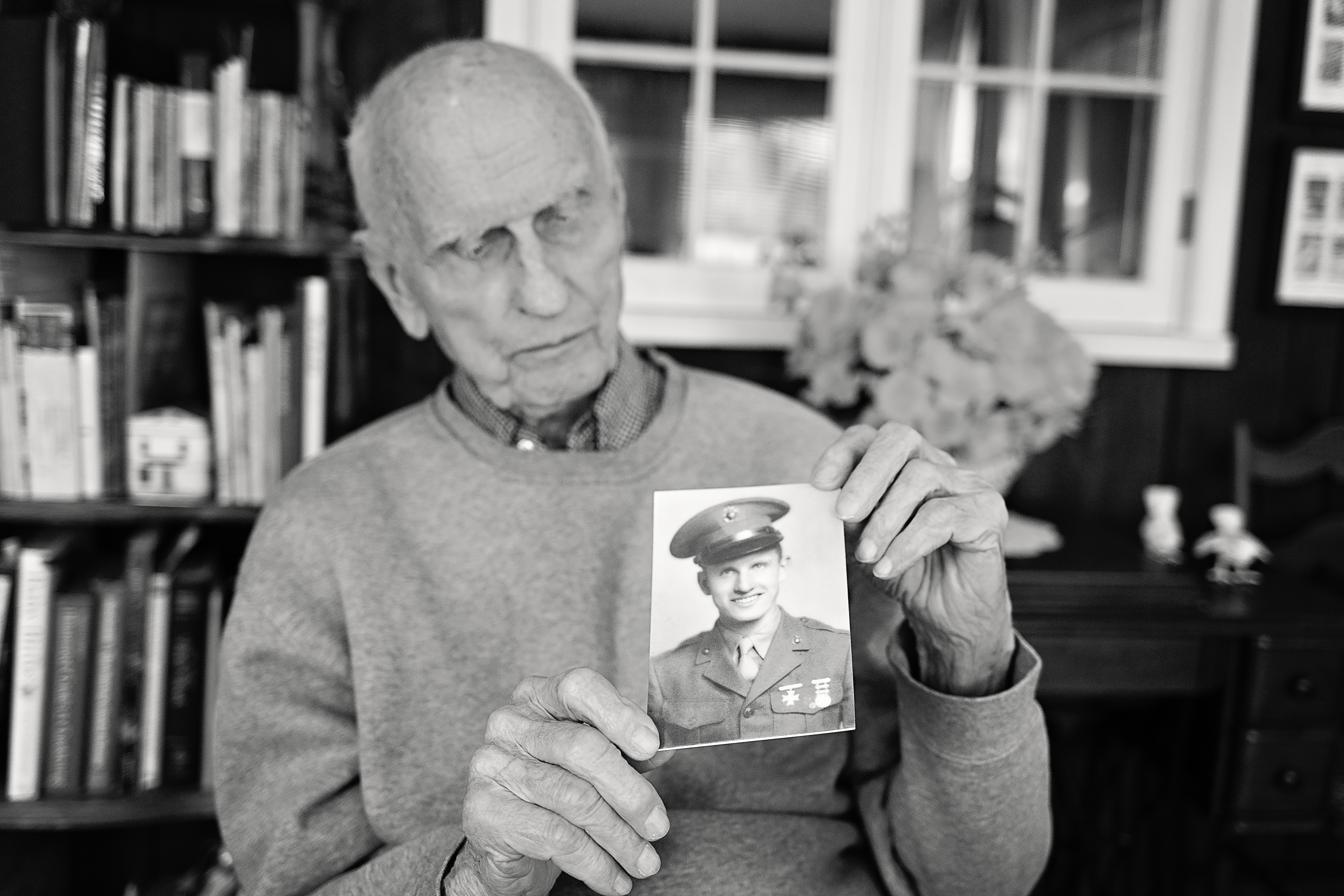
Bernie Ruchin
“If it looks like we were scared to death
Like a couple of kids just tryin’ to save each other
You should've seen it in color.
A picture's worth a thousand words
But you can't see what those shades of gray keep covered
You should've seen it in color.” — Jamey Johnson
They say cats have nine lives. Cats have nothing on Bernie Ruchin. Bernie has survived The Great Depression, two tours of duty in World War II, and the Korean War as a gunnery sergeant for the United States Marines. At 97 years old, this decorated war veteran is sharp as a tack. He’s earned his right to tell his story.
“During the Great Depression, I remember going to bed starving like you couldn’t believe. I could feel my stomach in my back. The few times my siblings and I had something to eat, it was just potatoes. That's all there was. My mother was raising us on her own. My mother endured a lot, and I didn’t notice just how much until I became an adult. I wish I had told her how much I knew what she went through and how much it meant to me. Coulda, shoulda, woulda.”
“When the Japanese attacked Pearl Harbor in December of 1941, I was too young to go to war. Having been born in 1924 didn’t get me even to 17 years of age. I tried to enlist and lie about my age, but I didn’t do a very good job. The recruiter didn’t buy it. My mother didn’t either. She said I needed to get my diploma first. That’s the best thing she could’ve done for me, looking back. I needed that diploma for jobs later in life.”
At 18 and fresh out of high school, Bernie got his high school diploma, and before the graduation ceremony, he joined the United States Marines, completed basic training, and was shipped off to war. “As a young male, I couldn’t get into war quick enough. I soon learned to be careful what you wish for.” In June of 1944, on an island in the central Pacific called Saipan, the USMC launched an amphibious attack. The invasion was brutal and bloody, and the battle was in close quarters. Bernie sums up his wartime in Saipan: “Saipan had the first city to contend with. Naval gunfire destroyed most of it. Moving through on the sweep north, one had to be cautious as the Japanese would lay under the debris or partially in the open faking death. To mitigate that, use your bayonet rather than shoot, wasting good ammo.”
“One morning, at about 0300, with the rattling of a few tanks, three thousand screaming Japanese charged the line. It was a typical Banzai attack, not for victory but a suicide attack to inflict maximum death. We would learn later on from intelligence that the Japanese commanding general issued the Banzai order with instructions to take seven lives for each one of theirs for the emperor. They came at us so fast that no one could reload their weapon to resume firing. It took bayonets, ka-bars, and fists, combined with sheer determination and courage, to survive that night. They breached the line toward Tanapag, and it took three days to root them out. No surrender ... Daylight came, and moving forward through the field of the attack, dead Japanese littered the landscape. Groups of a dozen or so, hundreds in the area of the main thrust. And, sadly, some of our Marines mixed in the smaller groups.”
“Several days later, looking over the crashing waves hitting the beach at the tip of Marpi Point, I looked towards the north where the Japanese home islands would be. I was with my platoon, and we talked about what island was next. I thought to myself about how long my luck would hold out. It was a serious thought.”
After returning home from WWII, Bernie was discharged from the Marine Corps. “Coming out of the gate off the base, I was walking, and a recruiter came along. I didn’t know he was a recruiter at that time. He offered me a ride home, and I took it. He asked me to join the Reserves, and how could I say 'no?' This guy just did me a favor.” “Saying 'yes' bought me a ticket to the Korean War. Who would’ve envisioned another war in that short period of time? No one saw it coming. You make decisions in life that at the time appear to be prudent and make sense, but in the long term, they don’t turn out very well.” Like WWII, Bernie fought hard and courageously in the Korean War. His bravery and injuries earned him two Purple Hearts.
“I tell this story to remind all Americans of the horror, savagery, and brutality of war. Everyone who serves in some capacity in all branches of services may have to engage in a life-threatening mission, some more, some less. But for me, and the thousands of my generation who answered the call to go in harm’s way, it is the ground pounder, the dog face, who is issued a rifle and a bayonet and given the order to engage within arm’s length. It becomes personal. Anyone who has experienced that comes out of it with scars, some invisible and some visible.”
Bernie knows that today it is a gift to talk about the war as freely as he does. It wasn’t always this way. “Going through the trauma of the war overwhelmed you. The memories of human flesh coming at you and death only a blink away. When it’s over, you just don’t forget it. You may put it away for the short term, but it will come back to haunt you.”
Returning to civilian life after serving in the war was difficult. Bernie suffered from PTSD and would often wake up in a pool of sweat. He describes his mental state: “It felt like you’re in a pressure cooker. It’s hard to describe. It’s a feeling I had never felt in my life. It isn’t a pain; it’s a mental phenomenon. It’s this pressure that is forcing you down. It overwhelms you. You have to use your mind to get off that feeling by thinking of something positive. You need to take your mind away from your war experiences. It takes time. I did it without any medical intervention. We didn’t have mental health services back in those years from our government or the VA. It was nonexistent. You had to come out of this with your own strength, which, luckily, I was able to do. No drugs or alcohol. I accepted that this was a part of my mental healing. Ridding myself of the experience. Toning it down so it wouldn’t overwhelm me. As time goes by, it's like a cold wind that blows into a room through an open window, and you feel the chill of it right away. Then someone closes the window, and it’s not as cold. Then someone closes the window, and it’s gone. It’s a series of steps. It's mythology I used, and for me, it worked. I can sit back today and talk about things that I could never talk about before — because it would resurrect bad memories.”
After both wars, Bernie became a state trooper in his hometown state of New York, among other adventures, and became a father. It wasn’t until Bernie got involved with the younger generation of Marines at the Reserve Center in Londonderry, NH, during the war in Iraq that he could open up about his experience. He felt like he owed them to speak up. “It was being with family. It’s a feeling you get when you talk to people who represent who you are. That’s the comfort of it. I knew I could try to help them mentally with the method I used myself.” Bernie found ways to help his family beyond talking about mental health because “Marines take care of each other.” That is why he co-founded Building Dreams for Marines, based out of Nashua, NH. “Building Dreams For Marines has been established to assist Marines and other service members who have mobility challenges with life-enhancing modifications to their homes or vehicles. For our brave men and women who have lost some aspect of their mobility, Building Dreams for Marines steps in to provide no-cost planning, designing, and building services. From access ramps and railings to stair lifts and more, our organization seeks to service those who have selflessly served America.”
Today Bernie spends his time relaxing at home with his girlfriend of 43 years, Miriam. He lives in a comfortable home situated on seven acres of land in Bedford, New Hampshire. He enjoys chocolate cake, watching the birds and wildlife from his sunroom, and woodworking. He is still active in advocating for his fellow Marines. “That’s the story of my life. Right there in black and white.”
You can learn more about and donate to Building Dreams for Marines by visiting BDFM.ORG/DONATE.