More Than a Name:
The Stories Behind Bedford’s Baseball Fields
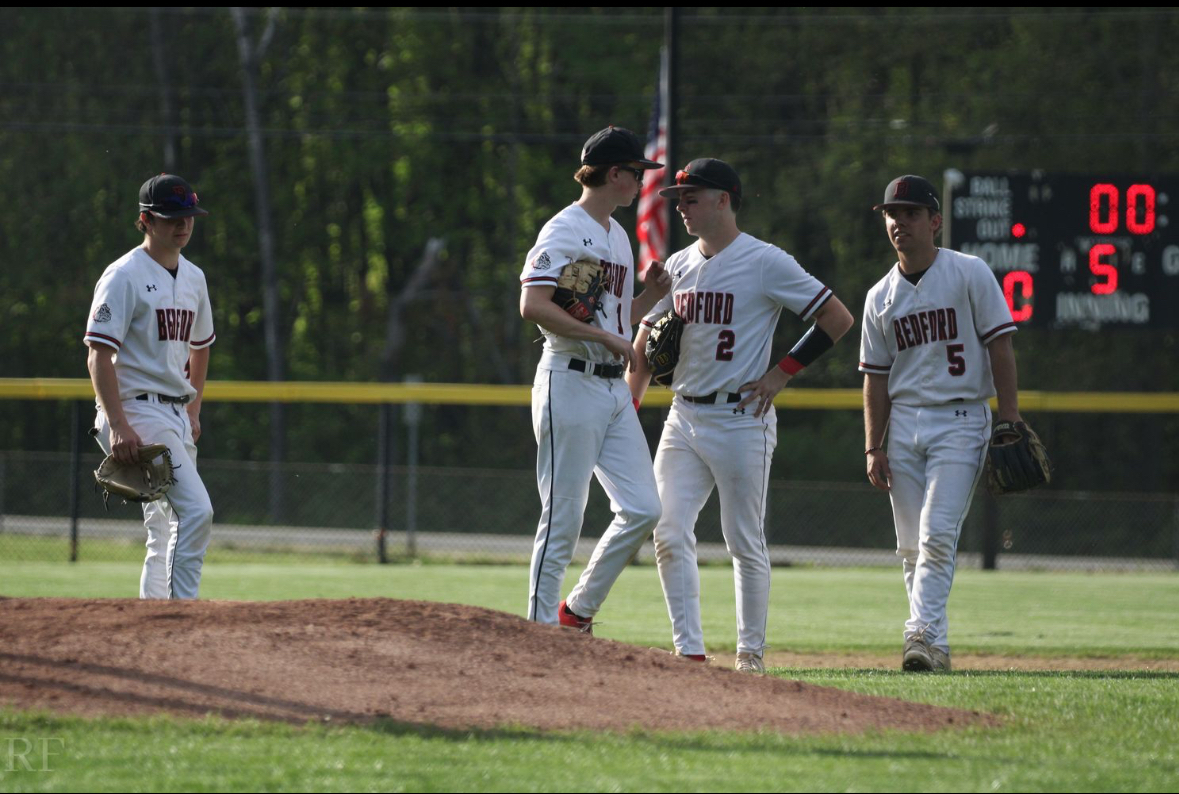
Bedford High School varsity infield players confer during a 2025 game at SAU Field. Photo by Ryan Foulis.
There is little doubt that Bedford has earned its reputation as a true “baseball town.” Last year alone, 440 children ages 4–14 participated in Bedford Little League, while Bedford High School fielded two teams with a combined 38 players. Bedford Legion baseball added three more teams, with 52 players competing at the 14–19 age level.
And baseball in Bedford isn’t just for kids. Drivers passing Riley Field may have noticed the New England Baseball Legends, a 50-and-over league that includes seven Bedford men, many of whom once played in the town’s youth and school programs themselves.
The 2025 season was a banner year on the field. Bedford’s Little League 12-year-old team advanced to the Little League Regional Championships, falling in the finals in Bristol, Connecticut, to the All-Star team from Braintree, MA. Bedford residents proudly watched the game live on ESPN. The Prep Legion 14–15-year-old team finished as state runners-up, while the Junior Legion 17u team captured both the State and Regional Championships.
While wins and championships help define Bedford’s baseball legacy, the town’s fields tell deeper stories- ones rooted in community, character, and remembrance. Several of Bedford’s baseball fields bear the names of individuals whose lives and values left a lasting impact on local baseball. The following stories explore the people behind those names and the legacies honored every time a player steps onto the field.
Marston Field Honors a Life of Service, Leadership, and Baseball
When players take the field at Marston Field at the Little League Complex on Nashua Road, they step onto more than a baseball diamond. They enter a space dedicated to the memory of Blake Marston, a standout athlete, devoted teammate, and U.S. Navy SEAL whose life continues to resonate deeply throughout the community.
The field was officially dedicated on June 13, 2015, just months after Blake Marston died in a parachute training accident in Florida on January 10 of that year. He was 31 years old.
Marston, a 2002 high school graduate, was known both for his athletic talent and his character. He attended The Derryfield School, finishing in 2001, before completing a postgraduate year at Northfield Mount Hermon School. Recruited to play baseball at the University of Connecticut, Marston later transferred to Stonehill College, where he continued his baseball career as a pitcher and first baseman.
Those who coached and played alongside Marston describe him as an outstanding young man and a terrific baseball player. His Bedford Little League Coaches for the 1995 Regional Championship team, Dave Burns and Skip Kelley, recall not only his skill on the field but his leadership and work ethic, traits that would later define his military service.
Following his senior year of college, Marston set his sights on becoming a Navy SEAL. Through determination and grueling training, he achieved that goal in October 2009. He went on to complete two combat deployments to Afghanistan, serving with distinction.
The dedication of Marston Field was a powerful reflection of the impact he had on those around him. Nearly all of his former coaches, teammates, and their parents attended the ceremony, underscoring the deep connections Marston forged through baseball. Bedford Little League President Kevin O’Connor organized the event and drew community members from across the area, making it a truly town-wide moment of remembrance.
Fundraising for the field itself was also a grassroots effort, spearheaded by a close-knit group of friends affectionately known as “The Baseball Moms,” whose commitment ensured that Marston’s legacy would have a permanent home.
Inside the dugouts, an inscription serves as a daily reminder to players of the values Marston lived by:
“Always respect and help your teammates, keep fit and strong, set high goals and be determined to succeed, accept discipline, always improve your skills, never quit, no excuses… Let this inspire you to be the best you can be.”
“These words summarize Blake,” said his mother, Nancy Marston, who now lives in Rye, NH. A separate monument near the town gazebo further honors his memory, offering visitors a quiet place for reflection.
Marston’s father, Bill, spent his career in education in nearby Goffstown, reinforcing the family’s deep ties to service and community. Today, Blake’s story continues to be shared by those who knew him best, including Bedford High School Athletic Director Corey Parker, a close friend and former teammate.
“As a coach in town, it was always a joy and a privilege to explain to my team why the field was named after Blake,” says Parker.
More than a decade later, Marston Field stands as a tribute not only to a fallen service member but to a young man whose life exemplified teamwork, discipline, perseverance, and selflessness, values that continue to inspire every player who steps onto the field that bears his name.
Ho Sang Field Memorializes a Love of the Game and the Spirit of Little League
For generations of Bedford children, Ho Sang Field has been a place of first hits, early lessons, and shared joy. Named in memory of John Ho Sang, the field stands as a quiet but powerful tribute to a young boy whose love for Little League baseball left a lasting impression on the community.
John Ho Sang passed away on April 23, 2005, at age 14, after sustaining injuries when he was struck by a vehicle while riding his bicycle in Bedford. He was remembered not for athletic dominance, but for something far more enduring: a genuine love for the game and for the experience of being part of a team.
“John was an average Little League player,” his mother said, “but he loved playing baseball in town.” That love began in tee-ball and continued year after year, as John eagerly signed up each season to play Bedford Little League.
In 2005, the Bedford Little League Board decided to dedicate one of its fields in John’s memory. The Ho Sang family was approached by then–board members Mitch Utell and Jackie Tims, who were serving as league president at the time. The family says they were deeply honored by the gesture and grateful that John would be remembered in a place that meant so much to him.
John’s Little League experience was shaped in large part by his time playing for Coach Dave Robinson, whom his family remembers fondly for emphasizing inclusion, skill development, and confidence-building over wins and losses.
“Every player was important,” John’s mother, Betty, recalled. “Dave helped everyone on the team develop their baseball skills and build their confidence.” For John, playing Bedford Little League was not just about baseball; it was about belonging, encouragement, and joy.
Today, Ho Sang Field continues to serve generations of young players, many of whom are unaware of the story behind its name. For the Ho Sang family, that continuity is part of what makes the memorial so meaningful.
“Having the field dedicated to John is a wonderful memorial at a place that he loved and enjoyed,” Betty said. “It’s wonderful that other children in town continue playing there and enjoying all that is good with Little League baseball.”
The plaque at the field reads, “A young man who embodied the Spirit, Integrity, Effort, and Sportsmanship symbolizing all that is good in youth sports and life. John always did his best.”
More than two decades later, Ho Sang Field remains a place where John’s love of baseball lives on in every season, every game, and every child who takes the field.
Games for Bedford Little League, from the Little League division through Majors, are played on Ho Sang and Marston.
Bernard Field Renamed to Honor Lt. Michael R. Bernard’s Legacy of Service and Community
At a recent January 2026 meeting, the Bedford Town Council voted unanimously to rename Swenson South Field as Lt. Michael R. Bernard Field, honoring a man whose decades of service to Bedford extended far beyond his role in law enforcement and deeply into the town’s baseball community. Bernard passed unexpectedly on February 22, 2025. This is the upper field at the Swenson Complex on Jenkins Road, used by Bedford Little League AA, AAA, and Intermediate teams.
The renaming followed numerous recommendations from both Bedford Little League and the Bedford Police Department, reflecting the wide-reaching impact Bernard had across the community. A member of the Bedford Police Department for more than 20 years, Bernard continued to serve even after retirement in a special role supporting police details and town events.
During his career, Bernard worked in patrol and operations and became a leader in community policing, an area many say best defined his approach to service. Community policing was not just a professional focus for Bernard, but a personal commitment and the way many Bedford residents came to know him.
That same spirit carried onto the baseball fields. Bernard was a longtime coach and umpire with Bedford Little League, coaching from the time his son Cam was six years old and continuing through the high school level for more than a decade. He also regularly volunteered as an umpire, often working games alongside his children.
Bernard’s dedication extended to the New Hampshire Special Olympics, another avenue through which he gave back to the community he cared so deeply about.
Today, Bernard’s legacy continues through his family’s ongoing involvement in Bedford baseball. His son Cam currently serves as Webmaster for Bedford Little League, is the District 1 Umpire-in-Chief, and sits on the league’s congress. Cam and his brother Ben both continue to umpire, carrying forward the values their father modeled.
“This means a lot, especially because he was a humble person and not always recognized,” Cam Bernard said. “I don’t think he realized how many people he touched. If he could look down, he would be surprised by how many people he impacted.”
Now bearing his name, Lt. Michael R. Bernard Field stands as a tribute to a man who believed in showing up, whether in uniform, behind the plate, or on the sidelines, and in building community through service, mentorship, and the game of baseball.
Riley Field: A Legacy of Service, Volunteerism, and Baseball
Riley Field, located at the entrance to Bedford High School, has long been a cornerstone of the town’s baseball community, representing decades of service, family involvement, and volunteer dedication.
The naming and construction of Riley Field were spearheaded in the mid 1960’s by David Riley, a U.S. military veteran, as an American Legion baseball project through American Legion Post 54. The field was funded and built by the Riley family, reflecting the Legion’s mission to support youth athletics and community engagement.
The Riley family’s contributions extended beyond the ballfield. The American Legion Post 54 building, also constructed by the family, stood for many years on Donald Street as a gathering place for veterans and community members. The building has since been repurposed and today operates as a daycare.
Riley Field continued to evolve through the efforts of other longtime community volunteers. In 1982, Rich Twarog, a Riley cousin, and Mark Rioux helped design and build the green fieldhouse on the field, contributing to what would become several thousand hours of volunteer service to the town of Bedford. Twarog’s work supported generations of children and families involved in Little League, the Challenger League, and Babe Ruth Baseball, alongside his wife, Sue Twarog.
In recognition of those efforts, the Bedford baseball community chose to dedicate the fieldhouse to the Twarog family, honoring their countless hours of volunteerism on and off the field and strengthening the family’s lasting connection to the facility.
Recently, a fieldhouse rebuild was completed thanks to donations and sponsorships from local businesses and families. Monies continue to be raised to finalize the inside and landscaping this spring. Anyone interested in learning how to support this community project can contact info@rileyfield.com.
Dave’s nephew, Tom Riley, who served multiple terms on the Bedford Town Council, including as chair, donated the first lights for the area, expanding the field’s use for evening games. Maintenance of the field in earlier years relied heavily on town staff and volunteers, as it still does.
Today, Riley Field stands as a testament to the impact of veterans, volunteers, and families whose behind-the-scenes efforts helped build and sustain one of the town’s most enduring community spaces. It is used by Lurgio Middle School, Bedford High School, American Legion Post 54, New England Legends, and various travel teams.
While these are just a few of the fields that serve more than 500 baseball players each season in Bedford, understanding the people behind their names helps highlight the values the sport and the community seek to pass on.
Those values were part of the conversation last March, when Article 4 failed at the March 11, 2025, Town Meeting by a vote of 2,977 to 2,067. The warrant article proposed $3.226 million in bonded funding for improvements to the Swenson Field Complex, the Nashua Road Complex, and the town skateboard park. While town citizens supported the project as a whole, many found the cost prohibitive and wanted to see a trimmed-down version.
Although the measure did not pass, Bedford Little League and other stakeholders continue to work toward long-term solutions. Ho Sang and Marston fields at the Little League Complex on Nashua Road were built atop the former town dump, limiting future upgrades, including the installation of new lighting, which town officials have said would be unsafe.
The Swenson Field Complex, originally built by developers, is considered a more suitable site for improvements such as field lighting and permanent bathroom facilities.
Current Bedford Little League President, Scott MacFarland, said the organization is regrouping after board turnover last fall and is currently focused on league operations, with broader planning discussions expected in the coming months. In the meantime, the league is budgeting for routine maintenance to keep existing fields safe and playable.
Similarly, Friends of Bedford Baseball continues to solicit community support to complete the fieldhouse at Riley Field.
Together, these efforts underscore the importance of ongoing investment in the facilities and people that help nurture a lifelong love of baseball in Bedford.
To learn more about town baseball in Bedford and how to support current projects:
American Legion Post 54 Baseball (ages 14–19):
post54baseball.com | legion54baseball@gmail.com
Follow Post 54 Baseball on Instagram
post54baseball.com | legion54baseball@gmail.com
Follow Post 54 Baseball on Instagram
To support or sponsor the rebuild of the fieldhouse at Riley Field:
rileyfield.com | info@rileyfield.com
rileyfield.com | info@rileyfield.com