The Bedford Presbyterian Church 275th Anniversary
The Weathervane
It is one of the most iconic symbols of Bedford, a gleaming white, stately structure, simple in its original colonial design, the Greek Revivalist portico being added later. The steeple, with its clock and bell tower, melodically reminds our citizens of the passing of each hour. The Bedford Presbyterian Church, fittingly, has come to represent Bedford because, in fact, it was necessary for the establishment of the town in 1750. Ironically, the founding of the church predates the town's birthday by a year to 1749. As we approach the 275th birthday of this symbol of Bedford, it is worthwhile to touch on the story of the church and the role it has played in the town's history. My personal journey with the church started in 2014 when my youngest son and I continued our family tradition of Scouting with Troop 414. Upon first setting foot inside the church hall, the only word I could find to describe the experience was "Welcoming." Over the years, additional words would be added to the list: adventure, friendship, safety, and fun… fittingly "welcoming" always remained predominant. As a prior Scoutmaster of the Troop, I'm filled with memories of laughing, happy young men eager to work on projects or set off on adventure, perhaps not too different from the original founders of the community as they planned the town's future. After attending worship services at the church, I was always impressed with the friendliness of the Congregation as they gathered afterward, enjoying coffee and desserts and the smiles and laughter that seemed to go hand in hand. It's hard not to wander outside and stand in the parking lot, overlooking the beautiful vista of the town, and wondering how many others stood in this exact spot in years past and shared in the enjoyment of this view.
Early Years
The story of Bedford itself begins in 1733 when land grants from the Commonwealth of Massachusetts were offered to participants or heirs of the Narragansett Wars of 1675. Each grant required that a "learned and orthodox ministry" be established with land set aside for the Minister, ministry, and school. Narragansett #5 would later become the town of Bedford. Many of the original settlers in southern New Hampshire were of Scotts-Irish descent, and they brought with them their Congregationalist and Presbyterian practices of Christianity. The religions trace their Protestant roots back to Calvinism and the Church of Scotland, where they were originally founded. Although they differ in organizational structure, it was not uncommon for a Congregationalist preacher to deliver a sermon to a Presbyterian denomination if ministers were in short supply. Such was the case during various portions of the Bedford Presbyterian Church's history. The church was the central social point of colonial life in Bedford, celebrating not only God's word but also creating an infrastructure for social events and philanthropic causes for the town's populace. In April of 1745, the first Presbytery of New England, the "Boston Presbytery," was constituted in Londonderry. On August 15th, 1749, the church of Bedford was organized in the Presbyterian form of Government. With the incorporation of Bedford as a town on the 21st of May, 1750, the search for a minister began.
The Ministry
Early attempts to find a minister were not entirely successful, with three candidates not accepting the call. It wasn't until 1757 that Princeton educated John Houston (ordained September 28th, 1757) became The Bedford Presbyterian Church's first Minister. Houston's first sermon was titled "Fear not little flock, for it is your Father's good pleasure to give you the Kingdom." He would go on to serve for 21 years until 1778 in a tenure marked with occasional controversies, including a lawsuit with Mathew Patten. In 1775, Rev. Houston was the only male Bedford resident not to sign the "Papers of Association" in support of the Revolution. Ultimately, this cost him his role as Pastor, resulting in his dismissal by the Bedford Presbytery in 1778, although he was still allowed to preach in other towns. He and his wife are buried in the Old Cemetery located off Back River Rd. For the next 26 years, various visiting ministers would preach to the Congregation.
It would not be until 1804 that another dedicated minister was assigned to the Bedford Presbytery, this being the Reverend David MacGregore, who was ordained in September of that year. He would serve until 1825 when "a committee was chosen to inform him of unhappy division which exists between him and his people and take such measures for his dismissal from his ministerial charge in said town as that may be thought best." The very popular Reverend Thomas Savage would lead the church for the next forty years, from 1826 to 1866. This beloved Pastor's highly successful tenure saw the expansion of the church during country-wide religious revivals in 1831 and 1864. He also saw the construction of the church building in 1832. In 1841, he authored "The History of Bedford," copies of which can be found in the Bedford Historical Society. Rev. Savage is buried across from the church in Bedford Center Cemetery.
The Bedford Presbyterian Church would ultimately see twenty-five ministers to date including; Rev Arthur Little 1866-1868, Rev Ira C. Tyson D.D. 1869-1879, Rev Daniel Colcord, 1881-1887, Rev Albert D Smith, 1888-1892, Rev Charles H. Fields, 1893-1896, Rev William Calvin Lindsay D.D. 1896-1899, Rev Albert P Watson 1900-1909, Rev Edward E. Weaver 1910-1911, Rev Francis D. George 1912-1915, Rev Norman H. Crawley 1917-1920, Rev Covert R. Thomas 1921-1922, Rev T. Lewis Williams 1923-1924, R.L. Dewey Burham, 1925-1929, Rev Charles F.H. Crathern, 1929-1935, Rev Wilbur J. Matchett, 1935-1940, Rev Richard Pacini, 1940-1945, Rev Michael Testa 1946-1948, Rev Walter Amos Morgan 1949-1958, Reverend James Scotland Jr, 1959-1982, Rev Jonathan Lange, 1982-1991, Rev Ruth Boling, 1989-1997, Rev Harold G. Williams Jr, 1992-2000, Rev Karen J Hagy, 1998-2012, Rev E. Nicholas VanGombos 2004-2010, Co-Pastor John Sawyer 2014- present, Co-Pastor Karen Hagy 2012-present.
The Physical Church
Although the members of the congregation are the heart and soul of the church, the physical presence of the Bedford Presbyterian Church is its classical New England architecture structure. The Church building itself did not exist until the year 1832; up until that time, the Congregation met in the Bedford Town Hall. With religious revivalism sweeping across the country, the size of the Bedford congregation grew, requiring a larger meeting house. The original building was a framed wooden structure measuring 71 feet by 51 feet in size without the beautiful portico we see now. It was built by Thomas Kennedy of Goffstown, who was charged with finding all the necessary materials to build the church and complete the project by September of 1832. The agreed-upon price being $3,700. Fittingly, on December 25th of 1832, the church was dedicated to the worship of God. In 1833, pews were sold, with the proceeds going towards the purchase of a bell. Any remaining money would be for the building of a parsonage. Sufficient money was only available for the bell, which was purchased three years later. Shortly thereafter, the bell cracked, and a new bell (the present one) would be hung in 1844. In 1870, a Vestry (Parish house) was built on the east side of the cemetery. The next major renovation would occur in 1881 when the entry was installed on the east side of the building between the two front windows, replacing the basement entrance. In 1894, the current veranda and columns were built, as well as the two-door entry in what is known as the Longfellow porch, as the architect was none other than the renowned Poet's nephew! This gave the church the beautiful entrance we see today. 1932 saw the removal of the forty horse sheds behind the church, opening the beautiful panoramic view of Bedford. In 1951, the Vestry was moved to its present location behind the church. 1994 saw the start of "Joel," which linked the two historic buildings with a new hall, offices, and classrooms completed in 1998.
In 1999, on the 250th anniversary of the faith family, General Assembly Moderator Freda Gardner summed up the structure rather eloquently when she stated, "We build upon foundations we did not lay; we drink from wells we did not dig, and we eat from harvests we did not sow. The faithfulness of previous generations…sustains and enriches us, and we are profoundly grateful for what they have bequeathed us." Pastor E. Nicholas VanGambos and Associate Pastor Karen J. Hagy continued in that vein as they added, "Indeed our God has been good to inspire a pioneer people and empower them to hand on to us this classic gem in the New England style, anchored firmly on New Hampshire's native granite stones. We have gratitude to extend – and, we have a destiny to fulfill!"
The Sanctuary was placed on the State of New Hampshire and National Register of Historic Places on the 21st of June 2007. Many of the most noteworthy and visible aspects of the church building have a story of their own worthy of discussion.
The Weathervane
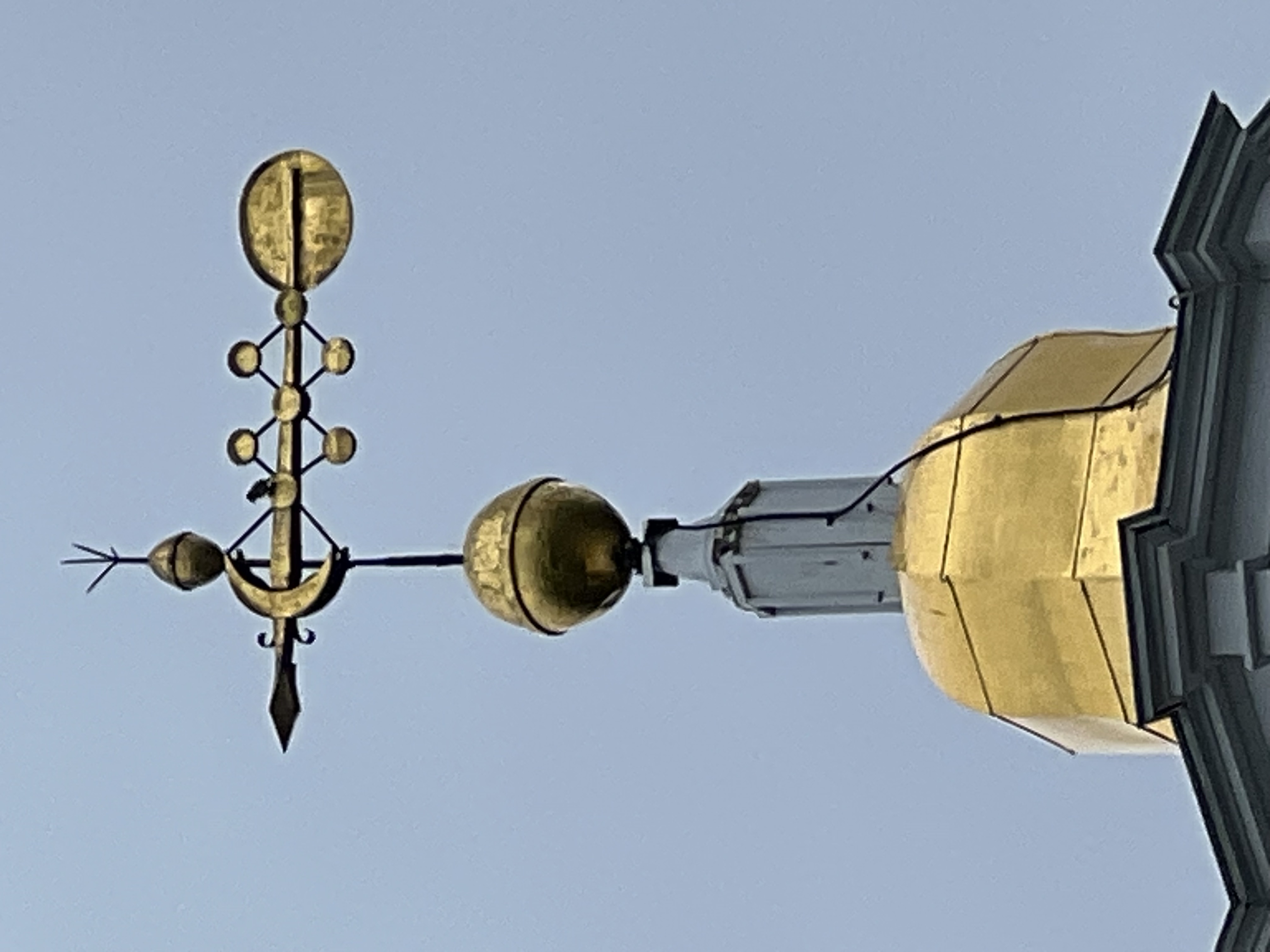
Adorned atop the steeple of the church is a weathervane manufactured by local blacksmith Nathan Kendall, his crowbar serving as its central axis. It represents the sun, moon, and seven stars as a remembrance for the congregation, urging them to "Remember the Sabbath Day, to keep it holy. Six days you shall labor and do all your work, but the seventh day is a Sabbath to the Lord your God." Exodus 20:8-12
The Bell Tower
The original bell, installed in 1832, fell and cracked shortly after its installation; it would not be until 1844 that a new bell would be installed once sufficient funding had been obtained. The new bell was manufactured by the Henry N. Hooper company of Boston, weighing over 50 lbs; it stands two and a half feet in height and seven inches in diameter. Originally, its rope hung to the vestibule floor where the Sexton rang the bell for 30 minutes prior to the sermon. Up until 1900, with the passing of a congregation member, the bell would be rung once for every year of their lives.
The Tower Clock
As Bedford grew more established as a town and life became easier, its' citizens began to focus on the town's appearance, particularly the Town Center. With the Town House on one side of the center and the Bedford Presbyterian Church on the other, "the energetic women of the church suggested a clock be placed in the church tower so its chimes would ring out across the fields and hills." With a nod from the town fathers, the Circle Ladies of the church began a fundraising campaign in 1894 for the purchase of a clock through petitions for donations ranging from fifty cents to ten dollars. The well-known E. Howard Clock Company of Boston provided designs and prices, and by 1898, $450 had been raised, and approval was given by the town for the installation of the clock in the church tower. The dedication took place on August 30th with speeches given by the Circle President, Mrs. Stephen Goffe; the Treasurer declared all expenses had been paid, prayers were offered by Rev Lindsay, and the Merrimack Marching band led the crowd to the Town Hall, where the Grange offered a free supper. The operation of the clock remains unchanged from its original installation. A box of crushed stones, weighing thirty pounds, is manually wound using a hand crank from the basement up to the belfry every seven days by the Sexton (whose salary is now $100 a year!) The thirty-pound hammer strikes each hour and can be heard throughout the town center.
Musical Instruments
Music has always been a central element of church life, and the Bedford Presbyterian Church had several musical instruments and a choir extending back to 1790 when the first base viol was introduced. In 1835, a small reed organ was donated by Daniel French for trial, although the results were not satisfactory. The next major musical instrument, a double bass viol, was purchased for $42.50 in 1849 and played by Mr. Elijah Stevens as part of Sunday services (the viol is currently on display in the church hall.) Instrumental music was added to the service the next year,1850, with the addition of a clarinet, violin, flute, and bassoon. An addition to the west side of the church was built in 1885 for a new pipe organ, purchased for $1,300 from George Hutchins of Boston. In 1970, renovation and repair of the organ was initiated for $11,000, with a recital taking place in October of 1971. A rededication of the organ was held on the hundredth anniversary of its purchase in 1995. The musical collection continues to grow with the addition of a Yamaha Grand Piano and a three-octave set of English handbells.
Housing Arrangements for Clergy, the Parsonage, and Project Joel
As part of the 1733 original Commonwealth of Massachusetts land grants for Narraganset #5 (Bedford), Townships were to agree to set aside plots for a minister, the ministry, and a school. Bedford's first minister, John Houston, was ordained in 1757, and he received land rights for a dwelling in accordance with the agreement. Initially, he lived with Mr. John Mclaughlin, who later built a house and moved into it with Mr. Chandler Spofford. In 1766, he built the "Houston" house in Bedford Center. As this was privately owned, upon his departure from the church, the house went with him and on to his heirs.
The next Minister who settled in Bedford was Reverend David MacGregore in 1804. He purchased a house on the corner across from the present Town Hall. At the conclusion of his tenure in 1825, the church bought this house for the sum of $600. In 1826, Rev. Thomas Savage became Pastor, serving until 1866 while living in a brick cottage built for him by Capt. William Patten. Upon his retirement, this house went with him as well. At this point, a Parsonage Association was formed to build a dedicated manse for future church leaders. Shares were sold to 31 investors at a cost of $25 per share. A brick building was bought from the Baptist Church for the sum of $500. This was later torn down, and the present manse erected in its place for just over $3,000. Initially, future pastors rented the manse at $200; ultimately, the rent was abolished. Over time, the shares were donated to the church, and by 1900, the church owned ten shares. In 1939, the Parsonage Association was dissolved, and the deed for the manse was granted to the church. From 1866 on, the manse has been occupied by either pastors or members of the church staff.
The first mention of a parsonage was in 1833, shortly after the church was erected when pews were sold to help finance the church, and "if money were left over, it should go the purchase of a bell, and if money were still left over, it should go the building of a parsonage." It wasn't until 1870 that the Vestry (later known as the Parish house) was erected on the east side of the cemetery. In 1951, it was moved to its current location with the addition of a basement, kitchen, and enlargement of the main room. Project Joel began in 1994 to link the church building with the Parish house, creating additional office space, a large hall, and classrooms. Dedication of this facility took place in Oct of 1998.
Social Activities
From its beginning, the church has served as the focal point for social interaction in the town. In this capacity, it has hosted The Ladies Circle (1848), Bedford Men's Club (1915), The Unity Club (1936), Boy Scout Troop (1943), The Mother's Club (1946), Senior Citizens Group (1974), and the Sweet Adelines. It continues to host a Youth Group (Children's Ministry), Choirs (youth and adult), Scout Troop 414, and The Circle.
The Church Family Today
Today, Bedford's Presbyterian continues its time-honored tradition of inclusivity, most recently with a display in the town library. "This display is a testament to the Bedford Presbyterian Church's history, ensuring it doesn't overlook the indigenous peoples who once thrived in this region. We believe in inclusivity and strive to honor all aspects of our shared history."
The church continues in its' traditional philanthropic role of serving the community, hosting a Food Pantry, Meal Ministry, Neighborhood Support Team (supporting Afghan families resettling in the area), Disaster Recovery Ministry (rebuilding homes and communities in Puerto Rico devasted by Hurricane Maria), Green Team (supporting environmental initiatives).
Volunteers are always welcome!
THIS LINE IS DIRECTION ONLY. Please put the text below in a sidebar or shadowbox alongside the article.
History and community intertwine seamlessly as Bedford Presbyterian Church (BPC) proudly celebrates its 275th anniversary, marking a significant milestone in the town's rich tapestry of heritage and faith. As Bedford Presbyterian Church embarks on this momentous occasion, it is the hope that the spirit of celebration and community connection fills the air. Step back in time to 1749 when the New World was unfolding and establishing roots in New England. This was a time when the founding of a church often preceded the establishment of towns under British rule. Bedford Presbyterian Church emerged as a center of faith and community spirit, charting the course for the establishment of the Town of Bedford the following year.
On August 18th, starting at 1 pm, BPC will host a free Community-Wide Picnic on the Village Commons (located down the hill from the Bedford Library), open to the public. Enjoy an afternoon of live music and various lawn games while connecting with friends and neighbors. BPC is looking to area businesses to offer for purchase a grab 'n go box lunch for participants, so bring a blanket and some lawn chairs and enjoy the day!
September promises new beginnings as BPC extends a warm welcome to all for its Annual Fall Welcome event. On September 8th, amidst the rustling leaves and crisp autumn air, the church parking lot transforms into a gathering place for neighbors and friends. Light refreshments, heartfelt conversations, and anticipation for the season ahead fill the air as the community embraces the changing landscape with open arms.
As the year draws to a close, BPC joins hands with local organizations to kick off the holiday season in style. December 7th sees the Bedford Women's Club Festival of Trees event held this year in the Fellowship Hall of BPC, with ticket sales available at the door. Venture down the hill for a traditional Christmas Tree lighting ceremony followed by a holiday story stroll past the Bedford Library. There is no better way to end the evening than with cookies and hot chocolate, shared amidst laughter and goodwill. At the heart of Bedford Presbyterian Church lies a deep commitment to inclusivity and acceptance. Regardless of age, race, culture, gender identity, sexual orientation, ability, or socioeconomic status, all are welcome. The spirit of love and compassion is abundant as individuals come together in worship, fellowship, and a shared purpose. As Bedford Presbyterian Church reflects on 275 years of faith, community, and tradition, it looks to the future with hope and anticipation, celebrating a legacy that aims to bring the Bedford community together.