Seeing Beyond Borders
Lessons from Ethiopia
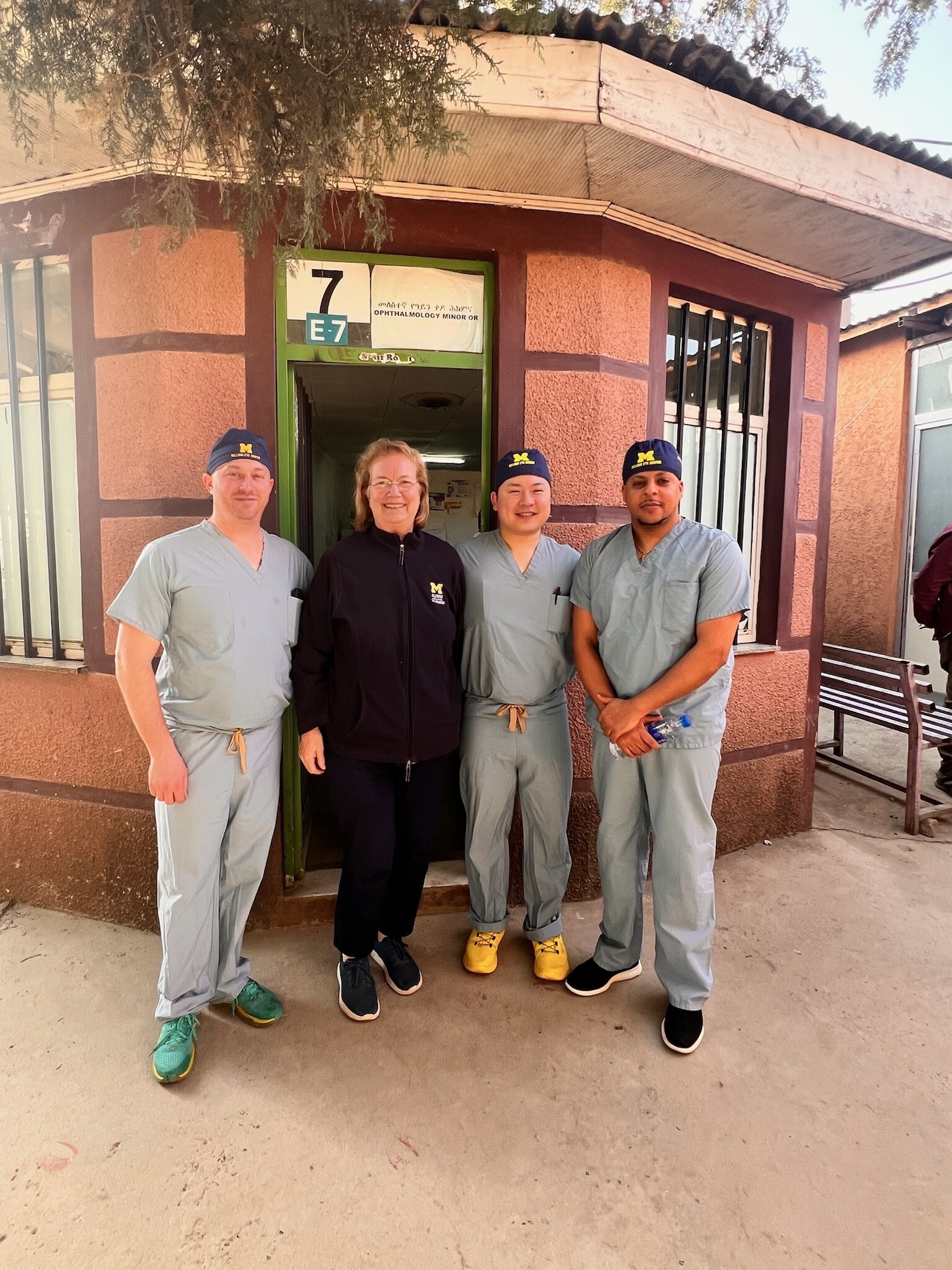
The visiting surgeon team consisted of (left to right): Dr. Dane Slentz, Dr. Christine Nelson, Dr. Cameron Yang, and Dr. Nathan Shekute. Dr. Slentz was a past fellow of Dr. Nelson’s at the University of Michigan.
Community service begins with a simple idea: use a skill to help others in need. While this often starts close to home, for physicians, it can extend far beyond, reaching communities where access to specialized care is limited, and the need is profound. At its core, service is not defined by geography, but by a commitment to show up where one is needed most.
As a board-certified ophthalmologist specializing in oculoplastic surgery, I care for medical and aesthetic conditions involving the eyelids, tear ducts, and eye socket. My work is centered on restoring function and beauty around the eyes with the goal of improving vision, comfort, and quality of life.
That purpose guides my work at home here in Bedford, where my wife, Ashley, and I are raising our two children, Scarlet and Lennon. I practice at Spindel Eye Associates and serve as section chief of ophthalmology at Elliot Hospital, caring for patients throughout southern New Hampshire. I also serve as the New Hampshire councilor to the American Academy of Ophthalmology, helping advance access to safe, high-quality eye care. These roles have reinforced that community service is not defined by geography, but by connection, trust, and the responsibility to meet patients where they are.
During my oculoplastic surgery fellowship at the University of Michigan, I was introduced to a global ophthalmology partnership with St. Paul’s Hospital Millennium Medical College in Addis Ababa, Ethiopia. The initiative is centered not only on delivering surgical care but on building long-term sustainable health care through education, mentorship, and collaboration.
In 2020, I traveled to Addis Ababa as part of this partnership, initially believing I would be contributing my expertise. Instead, it quickly became clear that the learning was mutual. I encountered pathology rarely seen in the United States, conditions presenting in advanced stages due to limited access to care, and worked in an environment that required constant adaptability. In addition to the language barrier, the lighting was dim, electricity was inconsistent, and instruments were limited.
One pattern was particularly difficult to confront. Many patients first sought care from traditional healers, who applied a caustic salve to the eyelids to treat conditions such as eyelid swelling and styes. The result was devastating chemical burns. I recall one young patient with severe bilateral eyelid scars in which the normal anatomy was nearly unrecognizable. The eyelids could no longer close. What began as a treatable condition had become a direct threat to sight.
In the operating room, the goal shifted from routine repair to vision preservation. Moments like this made the consequences of delayed and substandard care impossible to ignore. These challenges stripped surgery down to its essentials, reinforcing the importance of fundamentals, preparation, and sound judgment. The experience did not simply make me a more adaptable surgeon; it made me a more thoughtful one.
In February 2026, I returned to Ethiopia with greater experience and confidence, but also with a deeper awareness of how much there is still to learn. Resource-limited settings demand ingenuity and composure, reinforcing that surgery is both science and art: the science is rooted in anatomy and technique, and the art is expressed through real-time decision-making under constraint.
What stood out even more on my return was the severity and range of injuries we were treating. Many patients presented with extensive facial burns from open cooking fires, and others from the same caustic salves. We treated patients with complex trauma sustained during the recent civil war. We treated tumors that had progressed to the point where we were no longer able to save the eye. The damage was profound. These were not isolated cases but reflected broader gaps in access to early care, surgical resources, and the lack of reconstructive materials.
In the United States, many of these injuries are managed with readily available medications, grafts, implants, or tissue substitutes; in Ethiopia, those resources remain limited. That reality has shaped our efforts beyond the operating room. In response to this need, we have laid the groundwork with the Eye Bank of Ethiopia to expand access to grafts and tissues that can be transformative for reconstructive oculoplastic surgery.
One of the most meaningful aspects of this experience came not from the operating room, but from home. When my daughter Scarlet learned that I would be caring for children, she 3D printed elephant figurines for me to bring along. Sharing these simple gifts and seeing children’s reactions was a powerful reminder that service does not require specialized training. It requires compassion, creativity, and a willingness to connect.
These experiences also highlight an often-overlooked truth: service is never solitary. It requires sacrifice from those who travel, and from those who remain at home. Time away is real, and I am deeply grateful to my wife, Ashley, whose support makes this work possible. Her partnership reflects a shared commitment to service and a recognition that meaningful impact is built collectively.
My experiences have reinforced a simple but enduring truth: the principles of community service are universal. Whether in New Hampshire or Addis Ababa, it is about showing up, earning trust, and using one’s skills to improve the lives of others. Six years after my first visit, I left Ethiopia once again a better physician and surgeon.
And perhaps that is the most lasting lesson of service: when we offer our time and skills to others, we do more than make a difference. We are changed in return.
To support future global ophthalmology efforts like this mission trip, readers may consider making a gift to the Jerome Jacobson Global Program at the University of Michigan Kellogg Eye Center. Contributions help advance international eye-care partnerships, education, and service for communities in need. To donate, please visit giving.umich.edu/basket/fund/334389 and designate your gift to the “Jerome Jacobson Global Program” at Kellogg Eye Center.