More Than Friday Night
Miramonte head football coach, Nick Safir, is developing a program defined by character, connection, safety and championship ambition.
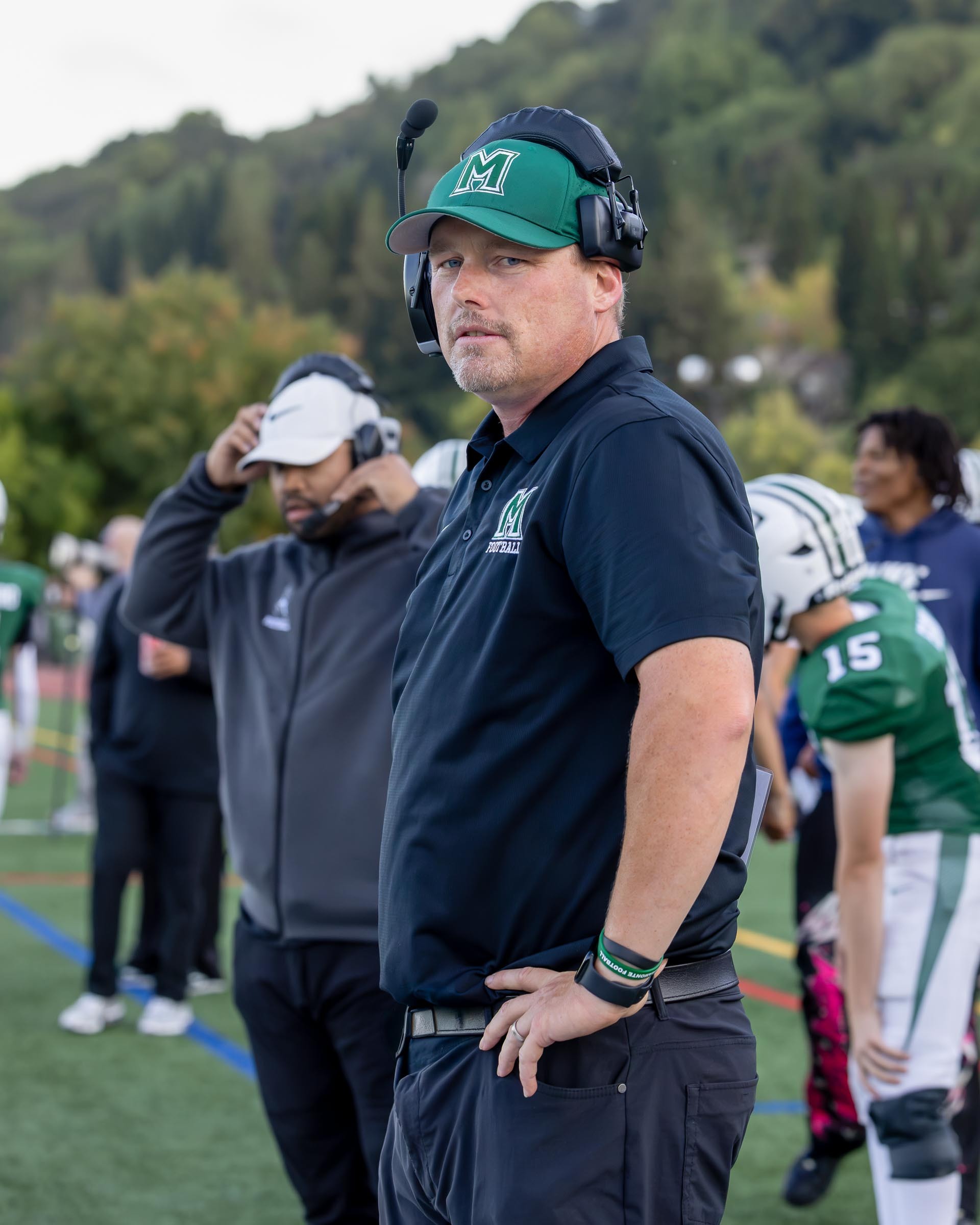
Head Coach Nick
Nick Safir knows a football program is measured on Friday nights. He also knows that the more important work happens long before kickoff.
Entering his third season as Miramonte High School’s head football coach, Safir is building a program around a straightforward standard: develop great young men first, then great football players. That philosophy has helped restore participation, strengthen the coaching staff and bring championship football back to the Matadors.
Safir grew up in Oakland and attended St. Mary’s College HS in Berkeley, where he played football & baseball. He continued playing football at Linfield College in Oregon, a small school with an elite program. He spent five years there and met his wife before returning to the East Bay, partly to remain close to his youngest sister, who is 11 years younger.
Sports had become too important to simply leave behind. Safir began coaching baseball at Piedmont High School in 2011, then joined the football staff and worked his way from the junior varsity level to varsity defensive coordinator. His coaching path later took him to Encinal High School, where he reconnected with his former freshman coach and mentor, Keith Miner, and then to Moreau Catholic.
For six years, Safir applied for head coaching positions and repeatedly came close. When the Miramonte opportunity arrived in 2024, he was ready.
“I always wanted to be a high school head coach,” he said. “I had a few experiences with coaches, especially at the high school level, that weren’t fantastic for me. I knew that if I ever got that opportunity, I wanted to do it better.”
Doing it better begins with seeing athletes as individuals. Safir is also a seventh-grade world history teacher in Hayward, working with approximately 150 students each day. Teaching and coaching require different kinds of flexibility, but both demand an ability to understand what each young person needs.
“The side of coaching that nobody seems to talk about is how much of an impact mentally and emotionally you can make on these kids’ lives,” he said. “You have to be careful about what you say, how you say it and who you’re dealing with. Every kid is different.”
That same expectation extends to his staff of 20 coaches across Miramonte’s freshman, junior varsity and varsity teams. Safir’s first requirement is not technical expertise. It is character.
“You have to be a great person first,” he said. “You have to care about these kids as people, not just as football players.”
The staff blends young coaches eager to grow with veterans who bring decades of experience. JV offensive line coach Gary Conlin has coached for 46 years and earned his first championship ring last season. Offensive coordinator Marcus Hyer, became an essential partner almost immediately. Defensive coordinator Matt Mills, a former Deer Valley head coach who previously worked with Safir at Encinal, joined the program last year and elevated the defense.
Safir describes Hyer and Mills as two additional head coaches within the program, reliable leaders he can lean on while setting the larger tone.
That structure paid off in 2025. After quarterback Carson Blair broke his collarbone late in the regular season, Miramonte turned to sophomore JV quarterback Lane Dalton. He led the Matadors through three playoff victories and an NCS Division 4 championship. Miramonte then advanced to the Northern California regional final, where another quarterback injury forced a freshman into championship-level varsity football.
The season ended one victory short of a state title appearance, but it changed the program’s expectations. Safir now sees greater depth, approximately 40 varsity players and a team that has been working since February to build on that run.
Growth is also visible at the freshman level. When Safir arrived, Miramonte did not field a freshman team. He made restoring it a priority, giving ninth graders the opportunity to compete against players their own age while entering high school with an immediate circle of teammates and upperclassmen who know them.
Safety remains central to that growth. Many players now use advanced helmets equipped with impact sensors that alert coaches when a hit requires attention. The data also helps the staff monitor accumulated contact and adjust practices. Safir said the program reduced concussions by 15 percent during its first year using the technology.
The wins matter, especially after a championship season. Yet Safir’s ambitions reach beyond another trophy. He wants Miramonte football to remain a place where students feel known, parents feel welcomed and coaches understand the responsibility that comes with being trusted.