From Worms to Robotics: Building Moraga's Next Generattion of Scientists
MEF-funded science labs give elementary students a hands-on start that carries through high school
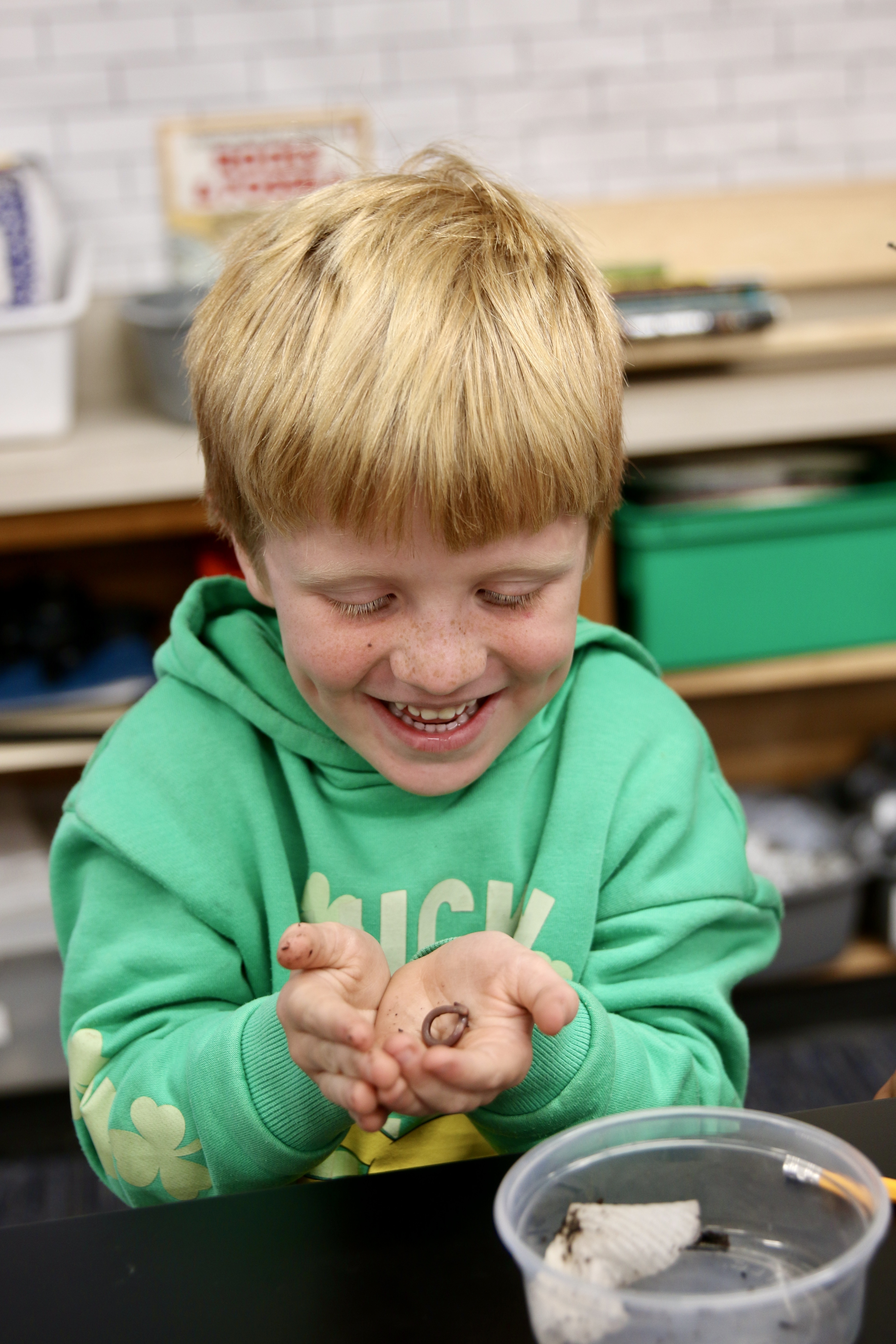
a Kindergartener at Camino Pablo learning about worms
Once a week at Camino Pablo, Los Perales, and Rheem, students leave their regular classrooms and head to a room that looks a little different: safety goggles, specimens to examine, and a credentialed science teacher waiting with the day's investigation. For the past four years, each of Moraga's elementary schools has had its own dedicated science lab, one of the programs made possible by your investment in the Moraga Education Foundation (MEF).
"The Moraga School District is proud to support continuity of instruction for science from elementary through middle school," said Dr. Julie Parks, Superintendent of the Moraga School District. "Our science teachers on special assignment use dedicated science lab classrooms to enrich science learning. With this focused approach to science, we are able to ensure that students are getting exposure to the Next Generation Science Standards and are prepared for the opportunities in high school and beyond."
In the lab, students learn by doing. During a recent Pollinator Unit, they tested honey samples, designed their own "super bee" hybrids, built hand-held pollinator tools, and dissected lilies to study plant anatomy. Lessons also build on each other over time: students first meet worms in kindergarten, and by fifth grade, they return to the topic with a hands-on dissection, analyzing structure and function and learning why worms are considered "ecosystem engineers."
Teachers also connect lessons to the wider world. When studying water, students learn that only 3% of Earth's water is drinkable, then consider what they could do about it and how science might one day help people use ocean water.
"Science becomes meaningful when students see how it impacts and relates to their world," said Millie Tang, elementary science teacher. "Every investigation helps our students see that science is not just a subject, but a way to understand, protect, and improve our world."
At Joaquin Moraga Intermediate, students continue with science in sixth, seventh, and eighth grade and can explore STEM electives such as Environmental Science & Sustainability, Magic of Electrons, Design & Modeling, Coding, and Robotics.
By the time they reach Campolindo, students can follow their curiosity wherever it leads. Beyond the core science sequence, which runs through AP Biology, AP Chemistry, and AP Physics, Campo offers Biotechnology, Human Anatomy and Physiology, AP Computer Science, Introduction to Engineering Design, Computer Integrated Manufacturing, Wood Tech & Engineering, and Automotive Engineering. Every student gets a strong foundation, and those who want to go deeper have a clear path to do so.
Your investment in MEF reaches every step of that path. This year, MEF Grants will fund science instructors and lab supplies for the elementary schools; science lab supplies and STEM electives at JM; and additional class sections, professional development, supplies, technology, and equipment for science and engineering classes at Campolindo.
For the students in goggles dissecting a lily today, that weekly lab may be the first step on a path that leads to a biotech lab at Campo, an engineering design course, or a career that hasn't been invented yet.
Make an investment, join our mailing list, and learn more at moragaeducation.org.