The Chief Who Knows Every Streetlight
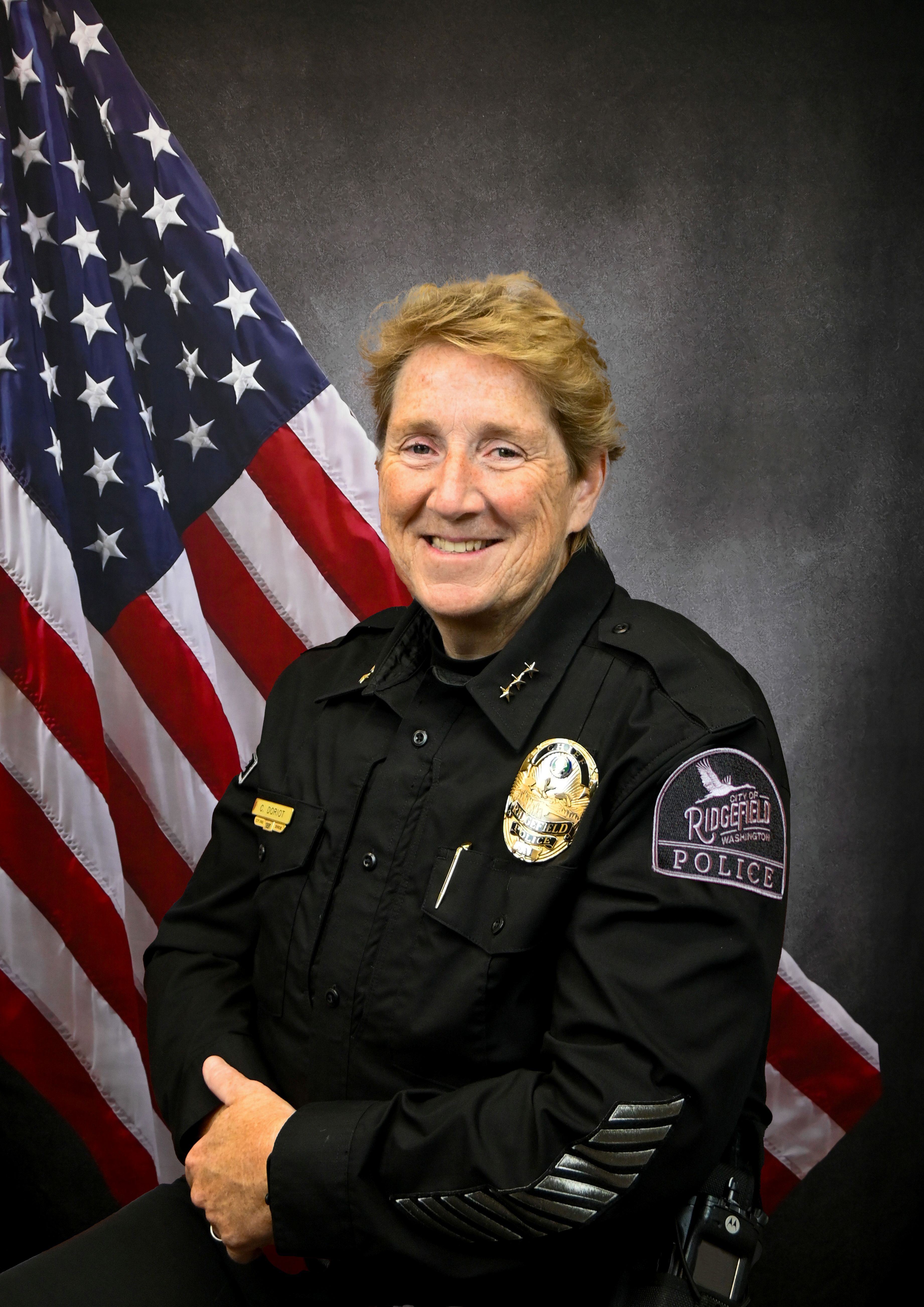
Cathy Doriot has served the Ridgefield community for more than 37 years, including the past three years as Chief of Police.
A lighthearted visit with Ridgefield Police Chief Cathy Doriot, whose career has been shaped by toy guns, community ties, quiet heroism, and a hometown she still loves enough to walk her dog at 3 a.m.
If you want to understand Ridgefield Police Chief Cathy Doriot, start with kindergarten.
On her very first day of school, young Cathy arrived dressed for the occasion in cowboy boots and a gun belt with toy guns. It was a different era, of course, but the school still called her mother, who would later become Mayor of Ridgefield, with a gentle correction: Cathy could come to kindergarten, but the guns could not. Looking back now, Doriot laughs at the memory. Maybe law enforcement was not so much a career choice as a plot twist that introduced itself early.
"I think it was a little bit destined," she says.
Raised by the Town She Would Later Protect
Doriot has lived in Ridgefield since she was three years old, back when the town was small enough that a kid could cover most of it by bicycle, horseback, or sheer curiosity. The rules were simple: go where you want, but be home by the time the streetlights came on, or when Sunday night television signaled that childhood freedom was over for the day.
Her memories of old Ridgefield remain vivid: the rocket ship behind the Starliner, horses tied up in town, and neighbors whose names were not just names but coordinates on a living map.
Even now, after more than 37 years with the Ridgefield Police Department and three years as chief, Doriot talks about the city less like a jurisdiction and more like family. Officially, she has served as officer, sergeant, lieutenant, interim chief, and chief. Personally, she has been part of Ridgefield's story, watching the community expand from roughly 1,100 people when she started in 1989 to nearly 20,000 today.
From One Office to a Real Police Station
The Ridgefield Police Department of Doriot's early days would be almost unrecognizable today. When she began as a reserve officer, the department had a chief, one officer, and a rhythm that depended on people doing a little bit of everything. Residents occasionally came directly to her house for help. One arguing couple even tossed pebbles at her window to wake her.
The Heroic Stuff and the Quiet Stuff
Regarding heroism, Doriot is quick to redirect the spotlight. Law enforcement, she says, is full of people who do heroic things every day without headlines, cameras, or applause. Most officers do not join the profession looking for recognition. They join because they want to help.
Still, there are stories. A routine traffic stop led to arrests in a nearby robbery, the recovery of multiple firearms, and prison sentences for the suspects.
That dramatic call is not the one that lingers most for her. The moments that stay with Doriot are quieter: a child who trusted her enough to disclose abuse, another whose behavior revealed pain beneath the surface, and a man on an overpass who did not jump because she stayed and talked with him.
These memories still catch in her voice. They are not flashy. They are not parade route stories. But they are the kind of stories that explain why community policing matters.
A Chief Who Leads With Her Heart
During our conversation, one thing became obvious.
"You lead with your heart," I told her.
She did not argue.
"Yeah, I do," she replied.
Under her leadership, the department expanded staffing, strengthened public safety resources, and continued adapting to a rapidly growing community. The Ridgefield Police Department also sponsors National Night Out each year on the first Tuesday in August at Abrams Park.
Doriot plans to retire on August 1 and is helping prepare the department for its next chapter.
When she speaks about her work, it all comes back to relationships. The people. The trust. The fact that sometimes a child tells you something because you showed up often enough to become safe. Sometimes a person in crisis lives because an officer is willing to listen.
In Ridgefield, public service is not separate from community life. It is woven into it.
Still Finding Ways to Make Ridgefield Smile
Doriot is the kind of chief who can return from a trip to Iceland with her wife, Bambi Heup, a retired Portland police officer, and bring home a civic improvement idea.
While traveling, she noticed a heart-shaped traffic light and immediately thought Ridgefield needed one. At first, state rules got in the way. Later, when the city was able to pursue the idea, she brought it back with cheerful persistence.
The result is a small, delightful downtown detail that feels exactly like Ridgefield: practical enough to be a traffic signal and whimsical enough to make people look twice.
That blend of seriousness and playfulness is part of Doriot's charm. She can talk about investigations, staffing, public safety strategy, and city growth, then seamlessly pivot to potato soup at a local restaurant, old police stations, Fourth of July celebrations, and the enduring pull of a hometown that is hard to leave.
Home, Still
Retirement may be approaching, but Doriot does not sound like someone planning to disappear. She talks about RV travel across the United States, finally enjoying the Fourth of July after 37 years of working it, staying local, and continuing to be part of the community that raised her.
She also hopes to volunteer with Cispus, something she has long hoped to do. She still has her own Cispus medallion.
Most of all, she still loves Ridgefield.
She speaks of the city with affection, protectiveness, and a little wonder. For Doriot, Ridgefield is not simply where she served. It is where she learned the names, the streets, the rhythms, the history, and the people.
And after nearly four decades in uniform, perhaps the best summary is also the simplest:
Cathy Doriot has spent her career protecting the place that first let her roam free until the streetlights came on.