Mercer Islanders Help Cure Cancer Faster
Three Island residents are joining thousands across the region for Obliteride, raising funds to accelerate research at Fred Hutch Cancer Center
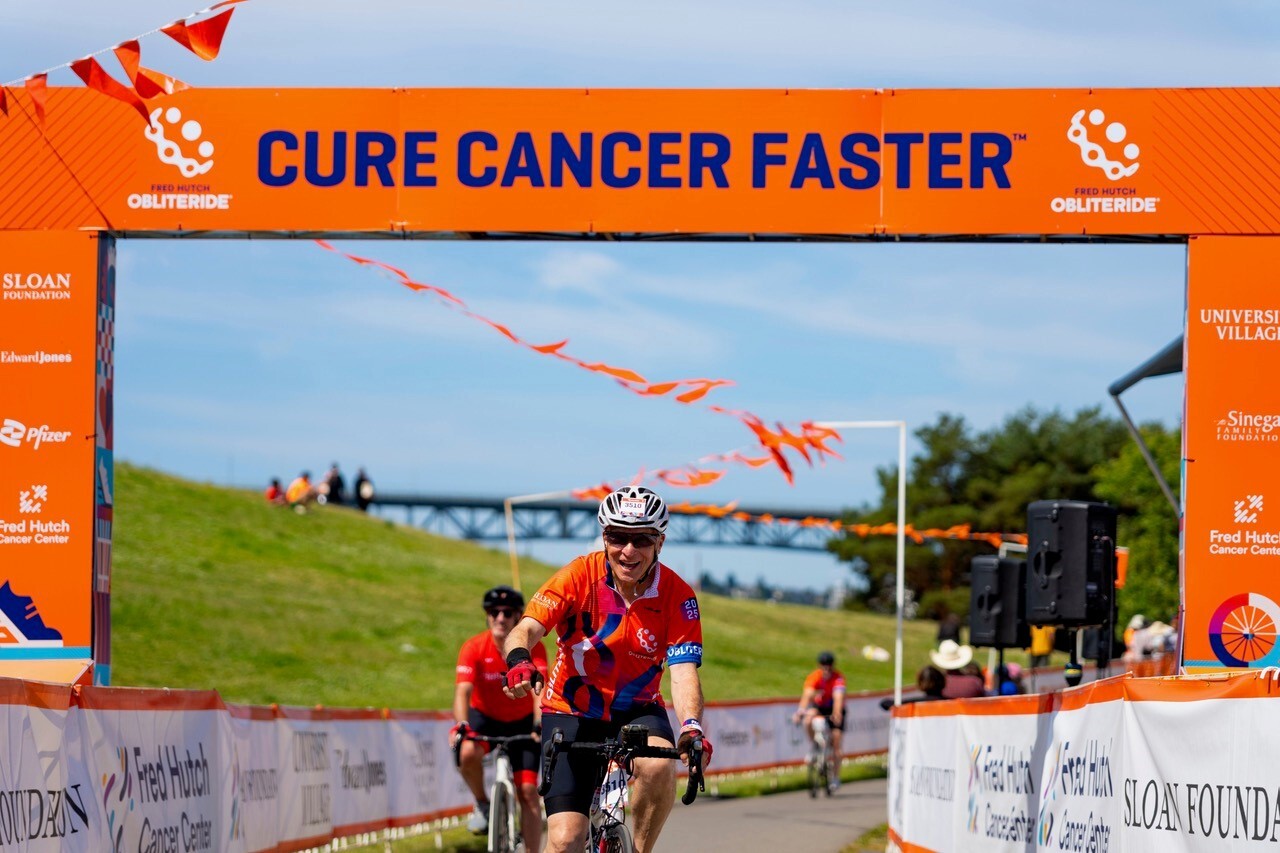
On August 8, thousands of orange-clad cyclists, walkers, runners, volunteers, and supporters will come together for Fred Hutch Obliteride, a bike ride and 5K walk/run that connects and empowers people to help cure cancer faster by raising funds for Fred Hutch Cancer Center. Participants will take on 25-, 50-, and 100-mile rides or the family-friendly 5K, united by a shared commitment to fuel groundbreaking discovery.
Nearly 100 Mercer Islanders participate each year, and for the upcoming Obliteride, Mercer Island will host the second-to-last rest stop for the 50- and 100-mile bike rides at the Stroum Jewish Community Center. Obliteride’s senior executive director, Tracy Evans, said, “We are delighted to be returning to beautiful Mercer Island this year. For more than a decade, neighbors have ridden, walked, volunteered, cheered, and fundraised for breakthroughs in cancer research, and we are thrilled that the Mercer Island community continues to be part of our annual tradition.”
Among those showing up every year are former and current patients, family and friends, researchers, and clinicians. We spoke to three Islanders whose passion for science and dedication to Obliteride's mission are helping accelerate progress toward new treatments and cures.
Jonathan Sham, MD, MBEE
For Mercer Island resident Jonathan Sham, chief of Hepatopancreatobiliary Surgery and surgical director of the Hepatic Arterial Infusion (HAI) Pump Program at Fred Hutch and UW Medicine, as well as associate professor at UW Medicine, Obliteride is an opportunity to connect with patients, volunteers, and community members of all ages. Each comes with their own unique motivation to advance cancer research, and the collective force of that energy is electric. “It feels like a party, a party with a mission.”
Since his first Obliteride in 2022, Sham, who specializes in gastrointestinal, liver, pancreas, bile duct, and gallbladder cancers, has participated in the 5K walk/run. “I do the walk with my patients, typically,” he said. Many are navigating pancreatic or liver cancers, two notoriously difficult-to-treat cancers. Every patient drives Sham to continue finding answers through his research so that they and future patients can not only survive but thrive.
His Obliteride team, “One Step Closer,” raises funds for his leading-edge research. This year, that includes research to develop a new drug for HAI pumps — small devices implanted under the skin that deliver high-dose chemotherapy directly to the liver with fewer side effects.
For 50 years, only one drug has been able to be administered using HAI pumps, limiting who can benefit. Creating alternatives could open this promising treatment to far more patients. “This could be a game changer," said Sham.
Sham has also helped his friends and family get involved, including his parents and children, now five and nine. "Every year, my kids go out in their orange shirts and hand out flyers," he said. He sees it as an opportunity for them to be part of something bigger than themselves. Plus, they look forward to the popsicles and face painting every year. "There's something for everyone."
Denise Galloway, PhD
For Denise Galloway, Obliteride is both personal and a powerful reminder of what sustained support for research can achieve.
In the 1980s, Galloway, a professor and holder of the Paul Stephanus Memorial Endowed Chair at Fred Hutch, helped prove the causal link between HPV and cervical cancer and unraveled essential details about the biology of the virus — discoveries that made the development of the HPV vaccine possible.
Her connection to Obliteride is also rooted in family. Her husband and fellow virologist, James McDougall, PhD, who also worked at Fred Hutch, died of cancer in 2003.
A decade later, during Obliteride's inaugural year, their daughter, Jean McDougall, now a staff scientist at Fred Hutch, honored him by riding the 25-mile route while Galloway, who describes herself as "not a biker," cheered from the sidelines. They have continued to participate over the years. Galloway has seen Obliteride grow from a small community ride into a movement thousands strong.
In the prime of her research on HPV, Galloway said, "I never worried about getting grants. Vaccine research was definitely supported." Today, government funding for research has become much more uncertain, making philanthropic dollars from Obliteriders and their supporters even more powerful in advancing the next life-changing breakthroughs in cancer research.
Larry Asher
Mercer Island resident Larry Asher has a drawer at home stacked with Obliteride jerseys. He's been a part of Obliteride for so many years that he can't quite remember how he first got involved, but the memory that rings clearest — and the throughline of his Obliteride experience — is the collection of reasons motivating people to participate.
"The stickers people put on their jerseys: 'I ride for ...' and the big three-sided chalkboard where people put up names. It really grabbed me." For Asher, those tributes drove home the feeling that cancer is a broad-scale problem that impacts countless people in a deeply individual way. No stranger to organized rides, he said that feeling is what sets Obliteride apart.
Over the years, Asher has added more stickers with the names of friends and family members to his jersey on Obliteride Day. "As you get older, you know more people who have had cancer. And not all of them survive it. That includes my brother, who did not survive cancer. It includes me, who did."
His ride has become increasingly personal, and his sense of urgency has grown. His method of fundraising is also personal. Each person he requests a donation from receives an email specific to them, with little "easter eggs" unique to their relationship.
This year, he has set a goal of raising $15,000 to support groundbreaking research at Fred Hutch. "This is crucial. I know the pain, and I would like others to not experience it.”
That sense of urgency has shaped Obliteride from the beginning. Now in its 14th year, Obliteride has grown from 355 participants in its first year to more than 5,000 participants in 2025. To date, the Obliteride community has raised more than $67 million, with 100% of participant-raised dollars going directly toward research.
This year, the community aims to raise another $10 million to accelerate advances in cancer prevention, detection, treatment, and cures.
Details
Friday Night Party: August 7
Obliteride Day: August 8
Participate in a 25-, 50-, or 100-mile bike ride or 5K walk/run.
More information about fundraising minimums, registration, and volunteering is available at Obliteride.org.